A Landmark Certification for Evondos VitaCam
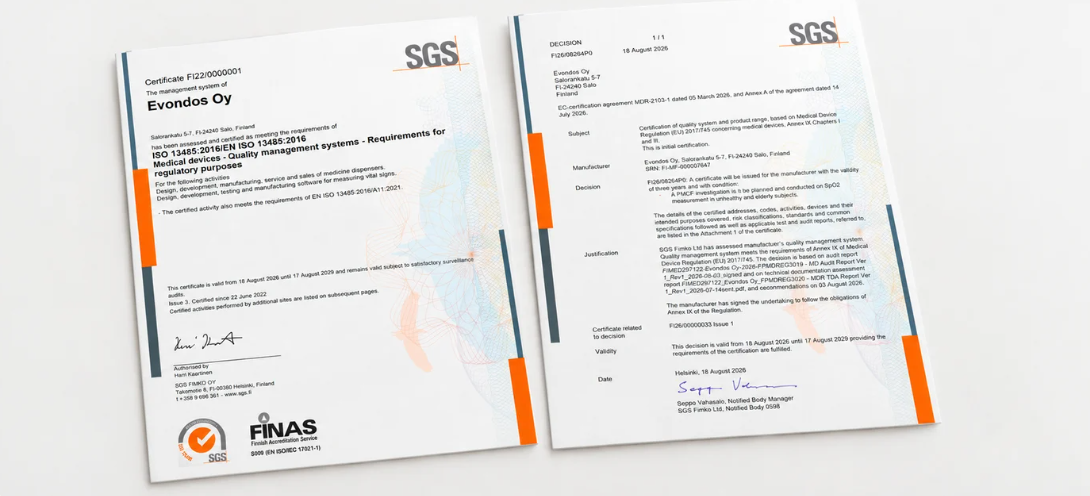
Evondos VitaCam is certified to measure oxygen saturation through a video of the face.
Evondos VitaCam “V2” has obtained the CE mark as a Class IIa medical device. The certification covers the measurement of oxygen saturation and interbeat intervals, in addition to the pulse and respiratory rate. This means that Evondos is the first company in the world to develop a certified medical device that can measure oxygen saturation in your blood simply by looking at you through a camera (known as remote photoplethysmography technology).
The technology itself has only been around for 20 years. VitaCam brings it into everyday care, without requiring a wearable or additional device.
VitaCam uses a standard camera, instead of purpose-built devices, to measure physiological signals by detecting subtle changes in light reflected from the skin that occur with blood flow.
What does this mean in practice? A caregiver video calls a client on the Evondos Anna medication dispenser and starts a 30-second measurement during the conversation. Results appear on screen while the caregiver is still talking to the client. In addition to a caregiver-initiated call, a client can record a 30-second video of themselves using a smartphone. Either way, nothing is worn, nothing is clipped to a finger, and no extra measurement hardware enters the home.
Certification at this risk class is rigorous. Achieving certification required extensive technical documentation, robust risk management, rigorous software development, thorough validation and several clinical investigations — turning years of pioneering research into a technology that can deliver real value in everyday care.
VitaCam is a Class IIa CE-marked medical device with clinically validated accuracy, and it is built to support clinical judgement, not to replace it.
Certification is one milestone. Real-world use is another, and VitaCam moved from development into customer use very quickly. It is now running with trained caregivers at initial customer sites in four countries, where structured feedback is collected over a short period to understand where VitaCam delivers the most value and what we should build next.
So far, VitaCam has been used in more than 300 video calls involving 60 caregivers and 130 clients.
“The nurses have liked it because it has been simple and easy to use. They have adopted it really well.” — Initial customer, Finland
“A good camera is very useful as we can see a lot and ask many questions, and now we can get measurements too. With measurements we can make even more confident decisions.” — Initial customer, Norway
Bringing medication dispensing, video calling and vital signs measurement together in one device is unique. A caregiver already calling a client can now see how that client’s vital signs are doing, without a trip, a wearable or an additional appointment. A new way of working always takes careful design, and the customers were keen to shape it rather than have it handed to them. That is why the solution is being built alongside them, in real homes, as we scale.
Care teams already know which visits matter. Evondos VitaCam gives care teams a way to see how someone is doing without making the trip first. That is what changes here: fewer trips made just to find out, more time for the visits that count, and for the client at home, the independence of a day that is theirs rather than one built around being checked on. Certification is what makes that possible at scale.
Source (text and image): Evondos